
For the past eight years, I’ve been leveraging (ding) data to develop AI that helps companies become more efficient or increase customers and revenues. I did a semester of AI for my degree but turned my back on AI for the bright lights of Consulting. Fast forward a few years and I’m responsible for AI and data platform deliveries. Even then, even with plain old machine learning, it was clear that AI would have a big impact on work. Fast forward another five years and we’re peering over the edge into a mist. Is it a long way down or an easy jump? Will we land in deep sea-water or impale ourselves on jagged rocks. I’m painting a dramatic picture here but the situation is already quite dramatic. According to McKinsey (“The Economic Potential of Generative AI”) generative AI could automate work activities absorbing 60% to 70% of employees’ time. As Head of Delivery, I was able to create a digital trust team with the dual responsibilities of information security and AI ethics. Back then, I’d say there were fewer than five occasions where we needed to think seriously about whether we should, given that we could. Now, with generative and agentic AI, there’s an ethical consideration almost every time. Oppenheimer struggled in his role leading the Manhattan project but ultimately knew what they had created could not been undone. It would certainly be hyperbole to compare AI with the atomic bomb but it’s right to accept that a technology has been created which has great disruptive, possibly even destructive, power… and can’t be uncreated!
So, there’s no turning back but how to move forward safely, ethically, responsibly.
Back to a previous Consulting life where we advised many clients (banks, airlines, utilities, departments, insurers, …) on anthropocentric technology. It’s a good place to start. Key then was to understand us humans and design digital system around this humanity, taking account of how people work and how we’re motivated. Such an approach is needed now.
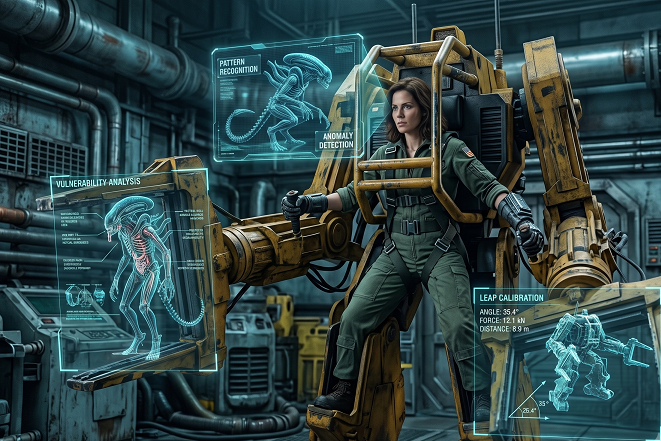
Over the past year, I’ve been sharing thoughts on the augmented human – “People Plus”. My inspiration is the P-5000 power loader from Aliens, made famous by Sigourney Weaver’s Ripley. Although bipedal, it had mechanisms to avoid toppling over (stable), greatly increased the operator’s ability to lift (enhanced abilities), was made of reinforced steel (resilient), enclosed Ripley in a harness and roll cage (protection), had an array of finger tip controls (ease of use) and had a hydrogen fuel cell mounted (powered). The loader allowed Ripley to control and finally defeat a Xenomorph – impossible for a normal, un-augmented human.
- Resilient
- Stable
- Powered
- Enhanced Abilities
- Operator Protection
- Easy of Use
It just so happens that I have a perfect example of People Plus. Cognitive Data Products (CDPs) combine the “truth” of well engineered and curated data ingestion with the comprehension & creativity of Large Language Models (LLMs). The result is something that provides the customer (be it a person or another agent) almost limitless expertise in a specific business area and a means to access this expertise on demand. Resilience is achieved through the data platform and LLM being utilised as-a-service (well architected) on your cloud platform of choice. Stability is engineered through logging, anomaly detection, auto-scaling and exception management. As well as obviously consuming electricity, CDPs are “powered” by continuous pipelines of streaming data as well as feeds of unstructured content such as policies & standards. Frontier LLMs (Gemini, Claude, …) have excellent in-built categorisation and regression capabilities as well as the innate ability to process huge amounts of structured and unstructured data (Gemini has a context window of at least 1m tokens). This is way beyond the abilities of us humans. Platforms such as Gemini Enterprise and Amazon Bedrock provide configurable guardrails so they can protect us from malicious others and from our own misadventures. Finally, CDPs have a conversational interface – no cumbersome menus, no forgettable commands.
So, Cognitive Data Products are my poster child for People Plus.
More next time.
 Volleyball, in its indoor incarnation, is played by two opposing teams of 6 players who try to ground the ball in the opponent’s 9m square court. In the way is a net raised to 2.24m for women and 2.43m for men. Each team can touch the ball three times before it has to cross the net so teams typically use specialists players to prepare (touches 1 & 2) for the best possible attack (touch 3). The average rally takes 5 seconds which typically involves a serve from one team followed by three touches by their opponents. This means our analysts have just over a second to record details of each “touch”.
 Rich, informative environment (eg scoreboard) helps memorability.
 Our experiences (captured as memories) form the basis of our capacity to plan, make sense of what’s going on and imagine alternative actions. Given the mass of information with which our digital world bombards us, recalling a specific piece of information can be difficult. The way we improve access to specific items is by coding them and the more codes we allocate to an item, the greater the likelihood of retrieval (document tagging takes this approach). Our challenge is that retrieval can be unreliable (there are insufficient cues to allow retrieval), affected by interference (the information available through processing does not match stored information), over-stimulated (there are too many entries with similar cues) and can decay.
 Vision shows us what things look like, how they’re structured and where they are. When a scene is viewed, the eyes rapidly move from one element to another in a jerky fashion. These movements are called saccades and at their end, the eyes rest and fixate on one point. Saccadic movement gives structure and texture helping us to derive greater meaning. The Gibsonian principle (JJ Gibson, 1979) covers such texture and is the theory behind the narrowing gaps between lines approaching roundabouts that prompt us to slow down.
 Attention is the way we direct our perceptual system to selectively focus on particular items of information in the face of several sources. Arousal describes an ad-hoc event that stimulates the allocation of our cognitive resources – looking at someone when they call our name. Studies have found that we experience difficulties when performing multiple activities; we’re overloading a particular cognitive resource (eg listening to two conversations at once). If, however, we can use different cognitive resources for the competing activities, we’re more likely to cope; consider listening to the radio and emailing colleagues as we commute to work.
 Language is not only a means of expressing thought (communication) but also influences our perception of the world. According to Sapir-Whorf, our experience of the world is enriched by the variety of the language used to describe it – Eskimos have a richer experience of snow than that of us in the West – you can ask Kate Bush why.
 Developing procedural knowledge involves practice; repetition tunes our neural network. When we practice, we organise clumps of information to support the task and then execute in sequences of clumps. Knowledge of results goes a long way to helping develop skills. Feedback can be intrinsic (spiking a volleyball gives immediate kinaesthetic feedback) or extrinsic (we’ll know how well we threw a dart if it hits the bullseye).
 These three stages appear in the refinement of vehicle gearing systems. Manual gearboxes are cumbersome and a pain in traffic (stage #1). Automatic gearboxes take all the pain away but also take away the control (stage #2) – it’s a bit rubbish if the car kicks down on the motorway when all you want to do is slowly accelerate. The next shift (excuse the pun) in transmission systems (sensonic, steptronic, tiptronic) allows drivers to decide when to change gears but removes the whole clutch nonsense. Great for Lewis and his F1 buddies but do we really need all that paddle activity? We thought we’d reached stage #3 but in reality, we’re back at stage #1. Today, I think we’ve got the balance right, true stage #3. The car decides when to change gears (no clutch, no paddles) but we can shift down or shift up if we want to do something particular. When the car senses that we’ve finished “active driving”, it quietly assumes control of the gearing decisions again. Automation has taken away the tiresome bits but we can assume the right level of control when we want.
 Our lesson here concerns the ability of humans to effectively take control. With my new paddle shift gearbox, the situation is one in which I decide when to take control having been steering, accelerating and actively sensing road conditions. If I’ve been completely disengaged from driving and the vehicle forces me to take control, my ability to do so safely may be limited.
 Firstly, Leon called NHS 111. The call handling agent was unable to do much more than take details (1st explanation) and referred to a clinical colleague. The out-of-hours clinician that called Leon back (booked by the 111 agent) carried out a triage covering the same ground (2nd explanation) as had been covered on the original call. Concerned, the out-of-hours clinician referred Leon back to 111 who made a booking into an extended hours hub (a product of the 2015 GP Access Fund). After a one hour wait, Leon was able to see a doctor at [coincidentally] his home practice. The extended hours clinician did (it’s assumed) have access to Leon’s medical history but no access to the 111 details so Leon’s explanations had to be repeated (3rd explanation). The extended hours clinician referred Leon to MIU for chest x-rays. This referral was rather chaotic involving an instruction to go to the MIU connected to A&E and a printed encounter summary. On Leon’s arrival at hospital, the nurse insisted on admittance to A&E (and not the MIU) but was not able to gain sufficient details from the encounter summary so Leon was forced to explain his condition again (4th explanation). The x-ray was booked and a number of other tests (blood, ECG) carried out by rather harried staff in an ad-hoc fashion. After a five hour episode of care, Leon was sent home with no clear diagnosis of what had happened but an assurance that he was OK. Two hospital nurses, two GPs, one hospital doctor, an x-ray technician, one healthcare assistant (who took Leon’s blood) and the laboratory (who mislaid the test results for a time) combined across four care settings (111, out-of-hours, extended hours, hospital) to provide Leon’s care.
 The big surprise for me has been since leaving hospital. I’ve been handed over to a new consultant but she has full access to my details as well as the treatments established. There are tests planned to ensure that the treatment has worked but much of my time with the consultant has been focused on explaining what’s happened, reviewing progress to date and advising me on how best to assure short and long term recovery. The advice has been really useful; I know where I need to play it safe and where I should push to accelerate progress. Though the planned tests will be an objective assessment of success, I feel that I know what they’ll show because the consultant has alerted me to the signs and I’m alive to how I can manage things to get the outcomes that I want.
 I’m not suggesting that we throw out the agile baby with the tar-pit bath water here, most definitely not. What I am saying is that we must shape our projects so that they deliver to order and, for digital, this covers faster. Agile development is a valuable part of this faster, better delivery but there are some essential architectural underpinnings if we want success; fast, efficient, on time and on the money.
 When building homes, for the majority of people, there are some fundamental principles. Before we get to deciding between Smeg and Miele, creation of space (whatever the external constraints) and maximising natural light will always be desirable. Similarly, flexible, non-oppressive security will be another winner. The same is true in building good technology; in parallel with reflecting specific requirements, there’s a set of principles to which almost all systems should adhere. It should be easy to move around into areas that suit our inclination without constantly meeting obstructions. We should also be able to benefit from natural illumination wherever we are… re-phrased, our way should be enlightened with knowledge as we go. Finally, while security becomes ever critical as more of our lives are lived online, we don’t want that security to be so oppressive that our use of the technology is impaired.